
Large bees (3/4″) and Extra Large bees (1” or longer)
Bumble bees genus Bombus

Texas Parks & Wildlife (TPWD) Species of Greatest Conservation Need
- American Bumblebee (Bombus pensylvanicus)
- Sonoran Bumblebee (Bombus sonorus)
- Variable Cuckoo Bumblebee (Bombus variabilis)
Click for Bumble Bee Atlas by the Xerces Society
Nine bumble bee species currently known to occur in Texas:
Bombus auricomus, B.bimaculatus, B.fervidus, B.fraternus, B.griseocollis, B.impatiens, B.pensylvanicus, B.variabilis, B.sonorus
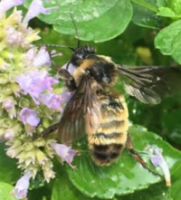
American Bumble Bee
Bombus pensylvanicus
Size: Extra Large 1″ or more
Season: Late emerging, mostly May-Oct
Description: main bumble bee in Houston area. Upper portion of thorax has a yellow band, the remainder is black. On the abdomen, the first 2-4 segments have yellow bands. Males tend to have more yellow bands on the abdomen.
Bumble bees are social and one of the only native bees that live in colonies, nesting in pre-formed cavities in the ground or trees.
Bumble bees are the only warm-blooded insect!
They are endothermic and can regulate their own body temperature and generate heat. Note: glyphosate (RoundUp) disrupts their ability to regulate temperature which affects their breeding ability. Journal Science (2022)
Many commercial beekeepers also use bumble bees to help farmers pollinate crops.
Bumble bees are a necessity, because honey bees won’t work gathering pollen when it’s raining or even overcast.
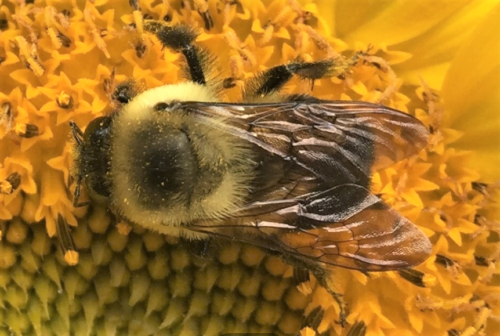
Brown-Belted Bumble bee
Bombus griseocollis
Size: Extra Large 1″ or more
Season: April – Sept.
Description: new bumble bee in Houston area, see here for more information. Named for the distinctive brown stripe around its abdomen, it can quickly be identified by its yellow thorax with a dark spot in the middle. On the abdomen, the first segment is yellow and the second segment is brown, which can vary to yellowish. The Brown-Belted Bumble bee is one of our largest fuzzy bees with queens up to 1 inch long.
Help track and conserve North America’s bumble bees!
Share your bumble bees photos with Bumble Bee Watch and use their BeeSpotter app.
Carpenter Bees
Five carpenter bee species genus Xylocopa currently known to occur in Texas:
Xylocopa micans, X.virginica, X.virginica texana, X.tabaniformis parkinsoniae
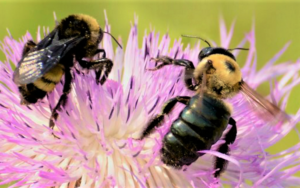
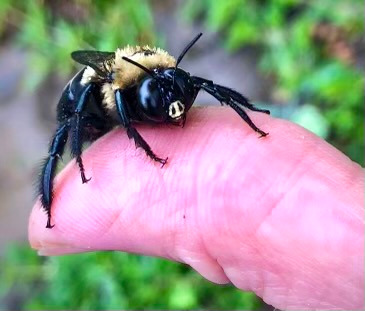
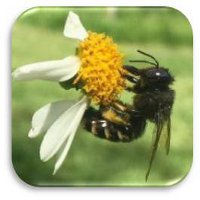
How do you tell a bumble bee from a carpenter bee?
The American Bumble Bee (left) has both a hairy thorax and abdomen.
The Eastern Carpenter Bee (right) has a hairy thorax, but a shiny abdomen.
So, if it’s “shiny on the hiney” it’s a carpenter!
Like bumble bees, carpenter bees (genus Xylocopa) are the largest native bees with hundreds of species worldwide.
Xylocopa is Greek for “wood-worker.” Carpenter bees are cavity-dwelling, usually in wood.
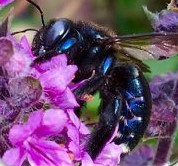
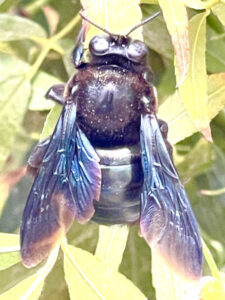
Southern Carpenter Bee Female
Xylocopa micans
Size: 1″ or longer
Season: Mar – Sept
Description: S. Carpenters have a large, black hairless abdomen with a yellow ring of hair on the thorax.
Their abdomen is deep purple (in contrast, Eastern Carpenter bees have a black abdomen).
Males have disctinctive greenish-yellow eyes.
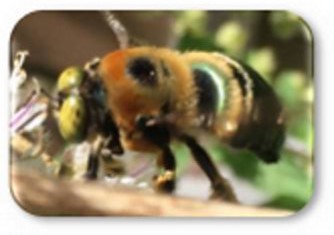
Southern Carpenter Bee Male
Xylocopa micans
Size: 1″ or longer
Season: Mar – Sept
Description: S. Carpenters have a large, black hairless abdomen with a yellow ring of hair on the thorax. Their abdomen is deep purple (in contrast, Eastern Carpenter bees have a black abdomen). Males have disctinctive greenish-yellow eyes.
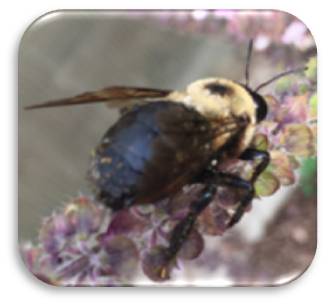
Eastern Carpenter Bee
Xylocopa virginica
Size: 3/4″ or more, “popcorn-size”
Season: Mar – Aug
Description: Large, black shiny abdomen with a yellow ring of hair on the thorax. Males have a yellow/white patch on their face.
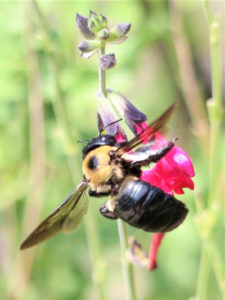
Texas Carpenter Bee
Xylocopa virginica texana
Size: 3/4″ or more, “pecan-size”
Season: Mar – Aug
Description: Subspecies of xylocopa virginica (eastern carpenter bee), their Texas cousin, also found in Oklahoma and Kansas. Similar in appearance, with large, black shiny abdomen, and thorax has yellow hair with black spot. The difference between Xylocopa virginica and Xylocopa virginica texana…texana has black dots on their clypeus, making it look like a little pig nose.
Horsefly-like Carpenter Bee
Xylocopa tabaniformis parkinsoniae
Size: 3/4″ or more, “popcorn-size”
Season: Mar – Aug
Description: This fast-moving carpenter bee has four distinctive “racing stripes” on the lateral portions of the abdomen.
Click for fun article by Texas Master Naturalist Alisa Kline “Best Little Carpenter Bee Ranch in Texas”
